Local Government Lawyer


Local Government Lawyer

SharpeEdge

Must read

LGL Red line
Slide background

Establishing relevant defects under
the Building Safety Act


The First Tier Tribunal has provided helpful clarity on what amounts to a
“relevant defect” for the purposes of Remediation Orders and Remediation
Contribution Orders under the Building Safety Act 2022, writes Sarah Grant.

Establishing relevant defects under
the Building Safety Act


The First Tier Tribunal has provided helpful clarity on what
amounts to a “relevant defect” for the purposes of
Remediation Orders and Remediation Contribution
under the Building Safety Act 2022, writes Sarah Grant.

Slide background

The Employment Rights Act 2025:
What Public Sector Employers Need to Know


Many of the changes in the Employment Rights Act 2025 will have a significant
operational and financial impact on public sector employers, particularly
local authorities and schools, where large workforces, high levels of unionisation
and public accountability increase exposure to risk.

The Employment Rights Act 2025:
What Public Sector Employers Need to Know


Many of the changes in the Employment Rights Act 2025 will
have a significant operational and financial impact on public
sector employers, particularly local authorities and schools,
where large workforces, high levels of unionisation and
public accountability increase exposure to risk.

Slide background

The Practical impact of the Procurement Act 2023
– the challenges, the benefits and the legal lacunas


In the second of three articles for Local Government Lawyer on the Procurement
Act 2023 one year after it went live, Katherine Calder and Victoria Fletcher from
DAC Beachcroft consider some of its practical impact and implications, including
how to choose the right regime, how authorities are tackling the notice requirements,
considerations when making modifications, and setting and monitoring KPIs.

The Practical impact of the Procurement
Act 2023 – the challenges, the benefits
and the legal lacunas


Katherine Calder and Victoria Fletcher from DAC Beachcroft
consider some of its practical impact and implications,
including how to choose the right regime, how authorities
are tackling the notice requirements, considerations when
making modifications, and setting and monitoring KPIs.

Slide background

Weekly mandatory food
waste collections


What are the new rules on food waste collections and why are
councils set to miss the March deadline? Ashfords’ energy
and resource management team explain.

Weekly mandatory food
waste collections


What are the new rules on food waste collections and why are
councils set to miss the March deadline? Ashfords’ energy
and resource management team explain.

Slide background

The Procurement Act 2023: One Year On -
How procurement processes are evolving


Katherine Calder and Sarah Foster of DAC Beachcroft focus on
changes to procurement design at selection and tender stage in
three key areas of change that the Act introduced.

The Procurement Act 2023: One Year On -
How procurement processes are evolving


Katherine Calder and Sarah Foster of DAC Beachcroft focus on
changes to procurement design at selection and tender stage in
three key areas of change that the Act introduced.
Slide background

Service charge recovery
and the Building Safety Act 2022


Zoe McGovern, Sian Gibbon and Caroline Frampton set out
what local authorities need to consider when it comes to
the Building Safety Act 2022 and service charge recovery.

Service charge recovery
and the Building Safety Act 2022


Zoe McGovern, Sian Gibbon and Caroline Frampton set out
what local authorities need to consider when it comes to
the Building Safety Act 2022 and service charge recovery.

Slide background

Fix it fast: How “Awaab’s Law”
is forcing action

Eleanor Jones sets out
what "Awaab's Law"
will mean in practice
for social landlords.

Fix it fast: How “Awaab’s Law”
is forcing action

Eleanor Jones sets out
what "Awaab's Law"
will mean in practice
for social landlords.

Assets of Community Value – a sporting revolution

Proposed reforms to the Assets of Community Value regime, particularly in respect of sports grounds, are important for local authorities to understand, writes Sadie Pitman.
April 17, 2026
Assets of Community Value – a sporting revolution

A new generation of development corporations

In the first in a series of articles, Thomas Horner looks at the role development corporations could play in delivering the new towns agenda.
April 17, 2026
A new generation of development corporations

Titchfield Festival Theatre - the new chapter. Or not, as it happens

The Court of Appeal recently clarified how s.57(4) of the Town and Country Planning Act 1990 applies when an enforcement notice is issued but planning permission is not required for some of the land concerned to revert to its lawful use immediately before an alleged breach.…
April 17, 2026
Titchfield Festival Theatre - the new chapter. Or not, as it happens

Housing offences and increased penalties

David Smith looks at whether the Sentencing Council’s proposed sentencing guidelines for offences related to housing will change local authorities’ approach to enforcement.
April 17, 2026
Housing offences and increased penalties

Permission for Take Off: £205m Cardiff Airport Subsidy Authorised by the CAT

This week saw the Competition Appeal Tribunal (“CAT”) hand down judgment in the case of Bristol Airport Limited v Welsh Ministers [2026] CAT 30. It’s a subsidy control case of particular interest, as it is the first to interrogate the level of detail required from the assessment…
April 16, 2026
Permission for Take Off: £205m Cardiff Airport Subsidy Authorised by the CAT

New Regulations for the Use of AI in Court Documents?

Fred Groves and Christopher Watkins provide insight into growing judicial concern about accuracy, professional responsibility and the efficient administration of justice in the face of Artificial Intelligence.
April 16, 2026
New Regulations for the Use of AI in Court Documents?

Children law update - Easter 2026

Michael Jones KC analyses the latest public law children cases of interest to practitioners.
April 15, 2026
Children law update - Easter 2026

Officer reports and decisions to close care homes

The Court of Appeal has confirmed the lawfulness of Kirklees Council’s decision to sell two adult care homes to a private provider. Peter…
Apr 15, 2026
Officer reports and decisions to close care homes

Ordinary residence - Worcestershire revisited?

Peggy Etiebet and Lee Parkhill analyse the amendments to section 117(3) of the Mental Health Act 1983 by the Mental Health Act 2025.
Apr 15, 2026
Ordinary residence - Worcestershire revisited?

Good practice in post-adoption contact

A Family Court judge has provided key guidance on post-adoption contact. Natalie Oakes sets out the main points from the ruling.
Apr 15, 2026
Good practice in post-adoption contact

The neighbourhood health framework

James Arrowsmith makes some initial observations for social care providers on the neighbourhood health framework.
Apr 15, 2026
The neighbourhood health framework

Public money and double recovery

The Administrative Court recently quashed a decision by a council to refuse to fund a disabled adult’s care needs and to seek repayment of…
Apr 14, 2026
Public money and double recovery

The new Housing Streamlined Route

Alexander Rose and Kanyinsola Lawal explain how public authorities can make use of the new 'Streamlined Route' for housing and assess…
Apr 14, 2026
The new Housing Streamlined Route

Planning committees and delegation

The government’s proposed reforms to planning committees and delegation could herald a new councillor–officer dynamic, writes Nagla Stevens.
Apr 09, 2026
Planning committees and delegation

Injunctions to restrain breaches of planning control

Mark O’Brien O’Reilly reports on a council’s successful application for a final injunction with both mandatory and restraining elements…
Apr 09, 2026
Injunctions to restrain breaches of planning control

Who bears the burden?

The High Court has confirmed the law on proving whether advertising consent has been obtained. Chris Jeyes considers the judgment.
Apr 08, 2026
Who bears the burden?

Lawfulness and applications for a CLEUD

The High Court has confirmed that lawfulness is to be determined as at the date of the application for a CLEUD. Jonathan Welch analyses the…
Apr 08, 2026
Lawfulness and applications for a CLEUD

The Cardiff Airport subsidy control ruling

The UK’s first aviation Subsidy Control case has been decided in favour of the Welsh Government. Alexander Rose considers the key elements…
Apr 08, 2026
The Cardiff Airport subsidy control ruling

Greyhound racing and the separation of powers

A recent judgment from the Administrative Court in Wales contains several points of interest for constitutional and public law…
Apr 07, 2026
Greyhound racing and the separation of powers

Dispensing with notice to father

It is vital that those representing local authorities or vulnerable parents understand the evidentiary threshold and procedural safeguards…
Apr 02, 2026
Dispensing with notice to father

Court of Protection case update April 2026

Lamis Fahad and Caitlin Smithey round up the latest Court of Protection judgments of interest to practitioners.
Apr 02, 2026
Court of Protection case update April 2026

Mar 31, 2026

Defective but not fatal

Craig Leigh looks at the Court of Appeal case of Duffy v Birmingham City Council, which involved an underlying housing conditions claim,…
Mar 26, 2026

The role of the backbench councillor

Backbench councillors in local authorities with a Leader/Cabinet model are often regarded as having little or no power to influence or take…
Mar 18, 2026

The powers of exclusion panels

On 5 March 2026, the High Court gave judgment in a case concerning two permanent exclusions. The judgment provides detailed consideration…
Mar 18, 2026

Removal from kinship care

A Family Court judge recently decided that a local authority’s removal of a six-year-old boy from his aunt’s care was wrongful. Eleanor…
Mar 13, 2026

Adoption vs long-term fostering

The Court of Appeal has dismissed an appeal by a local authority over a judge’s decision to refuse to make a placement order at the…
Mar 13, 2026

Care leavers and redaction of records

Is redaction of records necessary for privacy, or a cause of harm and frustration? Peter Garsden of the Access to Care Records Campaign…
Mar 13, 2026

Planning appeals and costs awards

Christopher Moss covers a recent judgment in which the Court of Appeal considered whether a Local Planning Authority had behaved…
Mar 12, 2026

The latest Sizewell C JR

The Court of Appeal recently refused permission to appeal in the latest Sizewell C judicial review, with the application certified as being…
Mar 06, 2026

Disclosure to the DBS

The High Court recently ordered a local authority to disclose to the Disclosure and Barring Service (DBS) findings made by the Family Court…

James Berry explains the tax context, the practical implications and key issues to address when implementing or modifying arrangements.

Background

Historically, HMRC treated local authority leisure services as business activities for VAT purposes, on the basis that authorities were not acting as public authorities when providing such services.

In 2022, following litigation brought by Local Authorities from across the UK, the Upper Tribunal (Tax and Chancery Chamber) considered whether leisure services fall within article 13 of the Principal VAT Directive (Directive 2006/112/EC) as activities carried out under a “special legal regime,” such that the authority is not a taxable person unless non-taxable treatment would distort competition.

Under Article 13, there were two conditions that needed to be fulfilled in respect of the activities:

(1) The activities had to be carried out by a body ‘governed by public law’; and

(2) the activities carried out by that body had to be ‘activities… in which they engage as public authorities’.

In the lead case in England (HMRC v Chelmsford City Council [2022] UKUT 00149 (TCC)) both HMRC and CCC did not dispute that the first test was met, but HMRC did not agree that that the First Tier Tribunal’s conclusion that s19 of the Local Government (Miscellaneous Provisions) Act 1976 was the source of the power to undertake the activity in question and, therefore, was the ‘applicable legal regime’.

The UT agreed with the Local Authorities and following a detailed review, HMRC accepted that allowing local authorities to treat their leisure services as non-business would not significantly affect competition and changed the VAT treatment such services as set out in Revenue and Customs Brief 3 (2023).

What does this mean?

Before 2023, Local Authorities that provided in-house leisure services to members of the public treated these supplier as “business activities” and either charged standard rated VAT to customers or sought to apply an exemption.

Now, Local Authorities can treat the leisure services as “non-business activities” and therefore they do not need to charge Output VAT.

Further, Local Authorities can claim back from HMRC the overpaid Output VAT they had previously accounted for to HMRC meaning potential cash benefits, with the added bonus of being able to backdate claims for up to four years.

Key VAT concepts

Business/Economic activity

VAT is chargeable to business (economic) activities, not to non-business activities. HMRC applies the test in Wakefield College [2018] BVC 22 as detailed in Revenue and Customs Brief 10 (2022)[1] to determine whether an activity is business in nature.

Stage 1: the activity results in a supply of goods or services for consideration

This requires the existence of a legal relationship between the supplier and the recipient. An activity that does not involve the making of supplies for consideration cannot be business activity for VAT purposes.

The Court of Appeal in Wakefield emphasised that a ‘supply for consideration’ is a necessary condition but not a sufficient condition for an ‘economic activity’.

Stage 2: The supply is made for the purpose of obtaining income therefrom (remuneration)

Where there is a direct or sufficient ‘link’ between the supplies made and the payments given, the activity is regarded as economic. The Court in Wakefield College [2018] made a distinction between consideration and remuneration. Simply because a payment is received for a service provided does not itself mean that the activity is economic. For an activity to be regarded as economic it must be carried out for the purpose of obtaining income (remuneration) even if the charge is below cost.

Input and Output VAT

Output VAT is the VAT that’s due on a seller’s taxable supply. Input VAT is the VAT that is charged on a business’s purchases and expenses, such as goods and services supplied to the business.

The following example shows how this works:
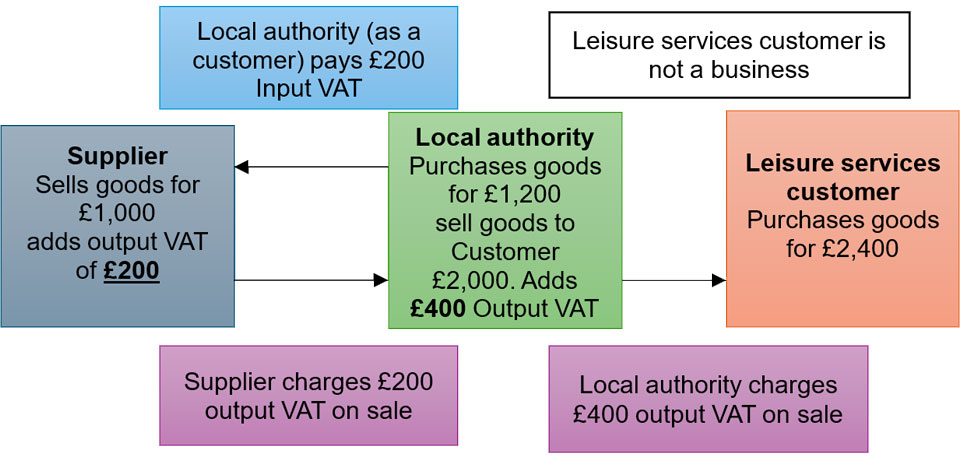
Previously, the local authority would report to HMRC:

  • Receipt of output tax of £400 (from the leisure services customer);
  • Payment of input tax of £200 (to the supplier)

The local authority, therefore, pays HMRC £200 (£400 received, less £200 paid).

Delivery model and the impact of the VAT change

Local Authorities deliver leisure services through a range of models, including direct provision, not-for-profit structures (e.g. charitable trusts), and for-profit leisure management contracts.

Where services are provided directly by a local authority, the new VAT treatment can be applied now.

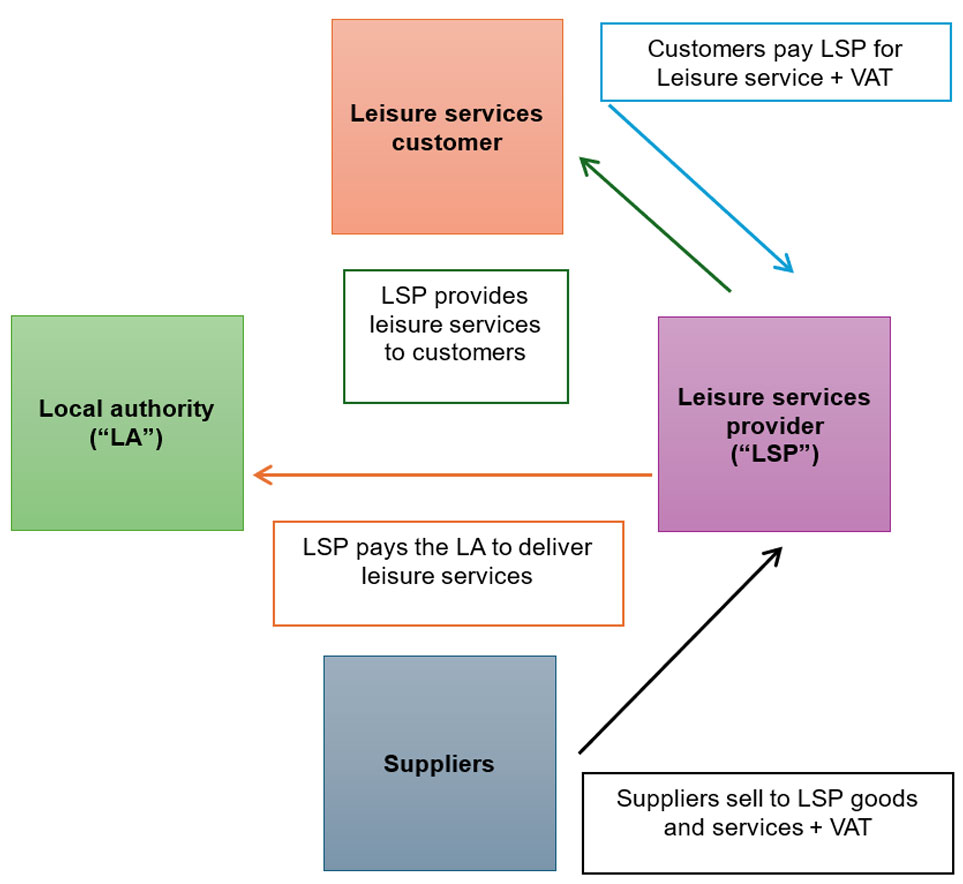
However, where an external leisure services provider (LSP) delivers the services under an outsourcing arrangement, neither the local authority nor the LSP benefits from the non-business VAT treatment.

Standard outsourcing model
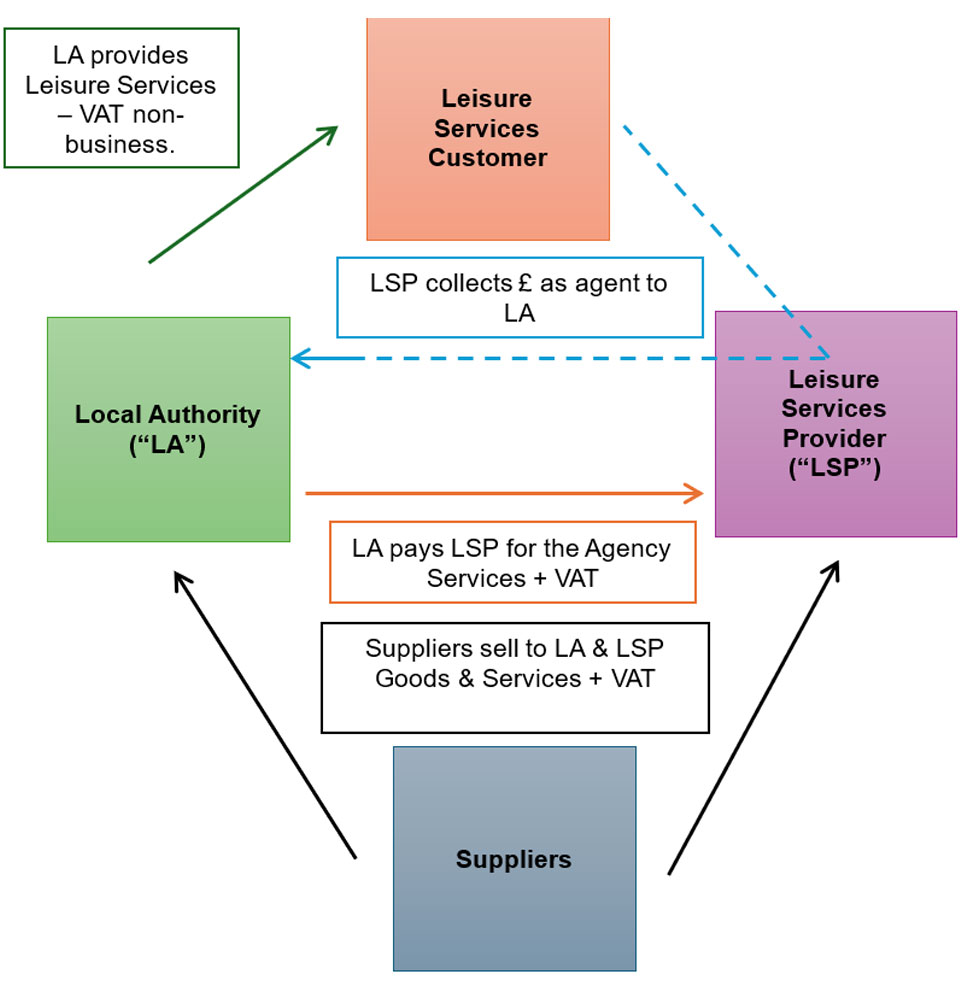
Agency Model

Under the Agency Model, the local authority appoints the LSP as its agent to provide leisure services on the local authorities’ behalf. The LSP collects income from service users and remits it to the local authority.

The local authority pays the LSP for agency services (plus VAT on those agency services), and the local authority recovers VAT it incurs on supplies to it, including from the LSP and other suppliers, while the leisure services to the public are treated as non-business by the local authority.

HMRC has previously acknowledged agency arrangements in the provision of leisure services, including in a 2007 memorandum of understanding concerning contracted out leisure-services[2].
Implementation considerations and risk

To secure the intended VAT treatment, the arrangements must operate as a genuine agency in both form and substance

  • Contractual clarity: The contract should clearly identify the authority as principal and the LSP as agent for the supply of leisure services to customers, and allocate rights, responsibilities and risks consistently with that position.
  • Operational alignment: Day-to-day practice must match the contractual agency, including branding and marketing in the authority’s name, income collection on trust or equivalent mechanisms, reporting, and segregation of funds. HMRC has indicated particular vigilance where existing arrangements are re-badged without substantive operational change.
  • Procurement compliance: Modifications to existing contracts must be lawful under the applicable procurement regime, whether the Procurement Act 2023, the Public Contracts Regulations 2015, the Concession Contracts Regulations 2016 or the Public Contracts Regulations 2006, depending on how the original contract was procured.
  • Business rates: The agency model is typically inconsistent with granting a lease or significant property interest to the LSP. This may remove access to mandatory and discretionary rates reliefs historically available to charitable operators. Authorities cannot claim charitable relief and non-charitable LSPs cannot obtain charitable relief; property and rating arrangements will need to be carefully structured.

Next steps

Local authorities considering a move to an agency model should assess VAT, operational and procurement implications in parallel, undertake a gap analysis of current outsourcing arrangements against a compliant agency structure, and plan for transition steps to ensure that contractual drafting and actual delivery are fully aligned.

Independent VAT and wider tax advice should be taken alongside legal advice before implementing this structure.

If you would like to discuss how the agency model could apply to your leisure portfolio, or require support with procurement or contract restructuring, please get in touch.

James Berry is an Associate at Sharpe Pritchard LLP.


For further insight and resources on local government legal issues from Sharpe Pritchard, please visit the SharpeEdge page by clicking on the banner below.

Visit Sharpe Pritchard's new Building Safety Hub, focusing on The Building Safety Act 2022 and its wide-ranging impact.

This article is for general awareness only and does not constitute legal or professional advice. The law may have changed since this page was first published. If you would like further advice and assistance in relation to any issue raised in this article, please contact us by telephone or email This email address is being protected from spambots. You need JavaScript enabled to view it..

Click here to view our archived articles or search below.

ABOUT SHARPE PRITCHARD

Sharpe Light Blue Bar 435px

We are a national firm of public law specialists, serving local authorities, other public sector organisations and registered social landlords, as well as commercial clients and the third sector.

Our team advises on a wide range of public law matters, spanning electoral law, procurement, construction, infrastructure, data protection and information law, planning and dispute resolution, to name a few key specialisms.

All public sector organisations have a route to instruct us through the various frameworks we are appointed to. To find out more about our services, please click here.

Justin Mendelle signature

OUR RECENT ARTICLES

Sharpe Light Blue Bar 435px

April 16, 2026

New Regulations for the Use of AI in Court Documents?

Fred Groves and Christopher Watkins provide insight into growing judicial concern about accuracy, professional responsibility and the efficient administration of justice in the face of Artificial Intelligence.
Click here for our archived articles

OUR NEXT EVENT

Sharpe Light Blue Bar 435px

SharpeEdge Event Slide

OTHER UPCOMING EVENTS

Sharpe Light Blue Bar 435px

Slide backgroundSlide thumbnail

OUR KEY LOCAL GOVERNMENT CONTACTS

Sharpe Light Blue Bar 435px

Peter CollinsPeter Collins

Partner

020 7406 4600

Contact by email

Find out more
 

Catherine NewmanCatherine Newman

Partner

020 7406 4600

Contact by email

Find out more
 

Rachel Murray-Smith

Rachel Murray-Smith

Partner

020 7406 4600

Contact by email

Find out more