- Details
Procuring and operating open frameworks under the Procurement Act 2023
This article seeks to provide contracting authorities (CAs) with the knowledge and guidance that they need to procure an open framework under the Procurement Act 2023 (PA23).
The introduction of the PA23 has given CAs access to new commercial tools designed to make public procurement more flexible, transparent and outcome focused.
One such innovation is the Open Framework, a development from the traditional closed framework model that authorities are familiar with.
Open frameworks offer CAs greater flexibility by allowing new suppliers to join at defined points during the life of the framework, helping to maintain competition, encouraging innovation, and support access for SMEs and new market entrants.
However, as this is a new concept under the PA23, CAs may be uncertain about how open frameworks operate, how they differ from existing frameworks and when their use is most appropriate.
Understanding the structure, benefits, and practical implications of open frameworks will be essential for CAs looking to make the most of the new regime, ensuring value for money, compliance with the Act and a more dynamic relationship with suppliers.
What is an open framework within the Procurement Act 2023?
An open framework is defined under section 49(1) of the PA23 as a ‘scheme of frameworks that provides for the award of successive frameworks on substantially the same terms’.
‘Substantially the same terms’ means the scope of the open framework, award criteria and that the terms and conditions should remain substantially the same (although frameworks in the scheme can be modified when the modifications are in line with s.31 of the PA23.
The key point here is that the framework will not require substantial change each time a new framework is awarded.
Under the PA23, open frameworks are a new type of commercial arrangement designed to make procurement more flexible and competitive.
They build on traditional framework agreements but address one of their key limitations – the inability to add new suppliers once the framework is established. Open frameworks allow CAs to:
- Reopen the framework at defined intervals – this is to admit new suppliers, ensuring continued competition and access to the latest market offerings.
- Run the framework for up to eight years, split into successive stages, giving longer-term flexibility while maintaining opportunities for supplier entry.
- Maintain competitive tension and innovation throughout the framework’s lifetime, as suppliers know the framework may reopen to new entrants.
- Support SME participation – by lowering barriers to entry over time, rather than limiting opportunities to those who joined at the outset.
- Use call-off competition (competitive selection procedure) – within the framework to award specific contracts, similar to traditional frameworks, but within a more dynamic structure.
In essence, open frameworks give CAs a structured but adaptable route to market by combining the efficiency of a framework with the flexibility of ongoing competition.
The attractiveness of open frameworks and awarding new frameworks to suppliers
The main benefits of an open framework are considered to be:
- Usefulness of markets that are developing and emerging. For example, AI/automatic services, cyber security, renewable energy, technology, fintech and digital payments. This provides more opportunity for innovation.
- The ability to add new suppliers gives CAs wider availability to the market, including SMEs and VCSEs. This is particularly important when buying in markets where the supplier landscape frequently changes, giving contracting authorities more buying options.
- Enhanced pricing competitiveness through offerings that align with market evolution, ensuring CAs receive improved value for money. This also helps CAs evidence that they are complying with the procurement objectives in s.12 of the PA23.
- There is a consistent and compliant buying process as each time the framework is opened, the same terms and conditions apply, or will not change substantially, throughout its lifetime.
Duration and reopening frameworks
Open frameworks have a maximum duration of eight years. Within the eight-year term, the framework must be reopened at least twice. This includes:
- the period of three years beginning with the day of the award of the first framework in the scheme, and
- each period of five years beginning with the day of the award of the second framework in the scheme.
Each framework’s term must also be clearly defined and transparent.
A new framework can only be awarded once the previous one has expired, and the final framework in the scheme must end within the overall eight-year limit. If a framework has expired, CAs can still complete ongoing contract awards as if it had not expired.
If only a single supplier is awarded the framework, the maximum term is reduced to four years, beginning with the day on which the framework is awarded.
Establishing and reopening frameworks
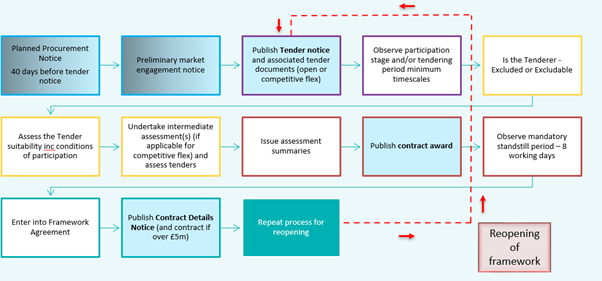
The process of establishing an open framework involves several steps. When reopening a framework, the process is repeated for each subsequent framework as shown in the diagram below.
The above steps will need to be repeated at each point a framework is reopened under the scheme. We are yet to see how administratively burdensome this could be for CAs operating open frameworks. CAs may look past this point due to the flexible nature that an open framework offers.
Award of new framework to suppliers
When re-opening the framework, there are restrictions on when existing suppliers can be appointed to the new framework.
If there is no limit to the number of suppliers on the framework, then the framework can be awarded to an existing supplier either by:
- Awarding on the basis of the supplier having previously been awarded a framework in the scheme i.e. there is no requirement for the supplier to submit a new tender if it does not wish to update its offer;
- Re-assessment of a tender relating to an earlier award; or
- The assessment of a new tender relating to the new framework.
If a CA limits the number of suppliers on the framework, then suppliers may only be awarded a framework to an existing supplier by:
- Re-assessment of the tender relating to an earlier award; or
- Assessment of a new tender relating to the new framework.
Call-off Contract Award – Selection Process
Once the framework has been established, CAs will be able to call-off from the framework. S.45(3) states that “Frameworks may only provide for the future award of a public contract by a competitive selection procedure” unless certain exceptions apply. This has replaced the ‘mini competition’ process under the previous regulations.
The requirements for a competitive selection procedure are outlined in s.46. This includes:
- Conditions of participation
- Assessment of proposals – but only by reference to one or more of the award criteria against which tenders were assessed in awarding the framework
- Refining the award criteria – for example, additional sub-criteria
A call-off contract under a framework can be awarded without going through a competitive selection procedure:
- If there is only 1 supplier on the framework; or
- If the framework sets out (a) the core terms of the public contract and (b) an objective mechanism for supplier selection.
Current Tender Notices for open frameworks
According to the Find a Tender Service (FTS), there were a total of 1091 Tender Notices published from the “go-live date” (24th February 2025 – 27th October 2025), advertising the procurement of an open framework.
The services are varied, showing that CAs are adopting the new approach under the PA23 to procure for some of their critical services.
These include ground works, transportation and infrastructure professional services, emergency response vehicles, care home development and many more.
Final thoughts on open frameworks
Whilst open frameworks promise greater flexibility and potential to encourage innovative procurement practices, it is still uncertain whether CAs will experience tangible benefits in practice.
A key question is whether the administrative effort required to establish and manage such frameworks will outweigh the intended efficiencies and creative opportunities they are designed to deliver.For advice and guidance on the Procurement Act 2023 and open frameworks, please get in touch with our team today.
Chantelle Pink is an Associate at Sharpe Pritchard LLP.
For further insight and resources on local government legal issues from Sharpe Pritchard, please visit the SharpeEdge page by clicking on the banner below.

Visit Sharpe Pritchard's new Building Safety Hub, focusing on The Building Safety Act 2022 and its wide-ranging impact.
This article is for general awareness only and does not constitute legal or professional advice. The law may have changed since this page was first published. If you would like further advice and assistance in relation to any issue raised in this article, please contact us by telephone or email
|
Click here to view our archived articles or search below.
|
|
ABOUT SHARPE PRITCHARD
We are a national firm of public law specialists, serving local authorities, other public sector organisations and registered social landlords, as well as commercial clients and the third sector. Our team advises on a wide range of public law matters, spanning electoral law, procurement, construction, infrastructure, data protection and information law, planning and dispute resolution, to name a few key specialisms. All public sector organisations have a route to instruct us through the various frameworks we are appointed to. To find out more about our services, please click here.
|


|
OUR RECENT ARTICLES
|
|
OUR NEXT EVENT
|
|
OTHER UPCOMING EVENTS
|

|
OUR KEY LOCAL GOVERNMENT CONTACTS
|
||
|
Partner 020 7406 4600 Find out more |
||
|
Partner 020 7406 4600 Find out more |
||
|
Rachel Murray-Smith Partner 020 7406 4600 Find out more |
||
|
|
||
|
Jo Pickering Partner 020 7406 4600 Find out more |
||
|
|
||
|
Emyr Thomas Partner 020 7406 4600 Find out more |
||
|
|
||
|
Gemma Duncan Partner 020 7406 4600 Find out more |
||
|
|
||
|
Simon Kiely Partner 020 7406 4600 Find out more |
||

 Catherine Newman