Running down the clock
- Details

In 2023, Sir Andrew McFarlane demanded that the vast majority of childcare proceedings are concluded within the statutory 26-week deadline. Three years on, Lottie Winson analyses the results of Local Government Lawyer’s follow-up research to see whether the Family President got his wish.
In November 2022, the then President of the Family Division, Sir Andrew McFarlane, demanded that the vast majority of childcare proceedings are concluded within the statutory 26-week deadline. He told all involved in public law children cases that delay had become “normalised” and that there needed to be a “radical change of culture within the family court”.
To overcome the level of delay in the system, he outlined a ‘20-point plan’ for family practitioners to follow in all cases from January 2023, to reconnect with the Public Law Outline (PLO).

In early 2023, Local Government Lawyer conducted a survey to gain an insight into the experiences of child protection lawyers and their views on the proposed changes, to assess their viability in practice.
Three years on, Local Government Lawyer has revisited the topic to assess how successful Sir Andrew’s reforms have been, what problems remain with complying with the 26-week target and whether further reforms are needed.
The current state of affairs
According to the Family President’s latest ‘View From’, written a short time before his retirement on 13 April, the average case duration for public law was 32 weeks in December 2025, down from 39 in December 2022.
Sir Andrew noted that although this “positive direction of travel” has been maintained for some time, in recent months there has been an increase in the volume of new cases being issued.
He warned local authorities faced with this situation not to step back from applying the pre-application strictures contained in the Public Law Working Group (PLWG’s) recommendations.
“On the contrary, a rise in volume should increase the need for sound case preparation, assessment and planning before any court application is made. Equally, where there is an increase in business in a court, the need for tight case-management (either under the Public Law Outline or in private law) is all the more important”, he warned.
Delays at every stage
Back in 2023, the aim of the original survey was to uncover where delays were occurring in child protection proceedings, to analyse whether the 20-point plan instructed by the President could address them.
The 20-point plan, which has been in place since January 2023, was set out by Sir Andrew McFarlane and the then Lead Family Presiding Judge, Mr Justice Keehan (see box out).
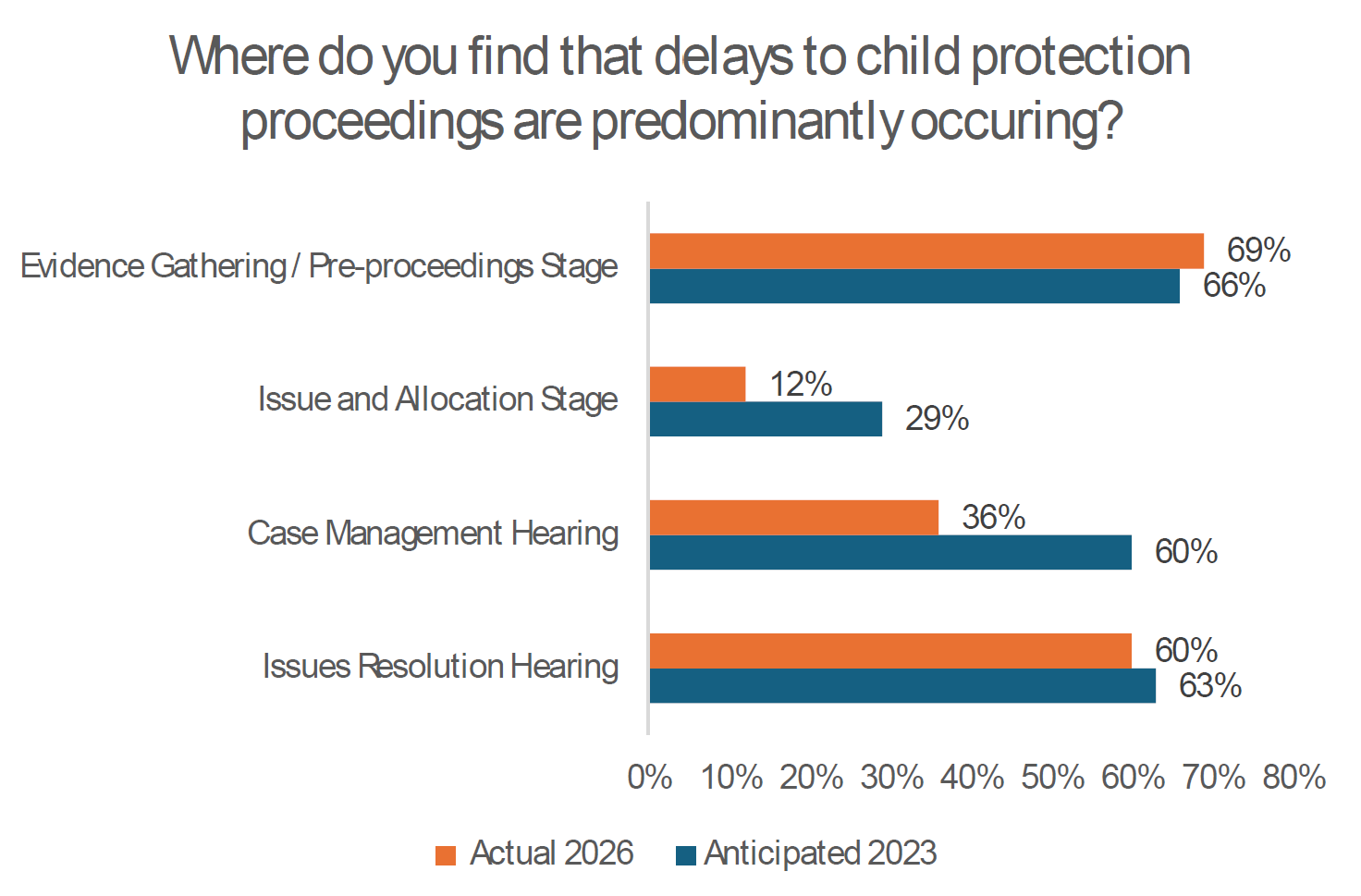
Asked where the delays were predominantly occurring, respondents to the 2023 survey noted delays across all stages - with the ‘Evidence gathering / Pre-proceedings stage’, the ‘Case Management Hearing’ and the ‘Issues Resolution Hearing’ being seen as having the highest number of delays.
Three years on, the ‘Evidence Gathering/Pre-proceedings Stage’ is still seen as the area with the highest instance of delay - with 69% of respondents observing delays in this area, followed by the IRH (60%).
In the Evidence Gathering/Pre-proceedings stage, key obstacles highlighted by the 2026 respondents include the late identification of kinship carers, a lack of parental engagement until they are “in the face of the court”, and delays in obtaining Police, Health and DBS records.
One wrote: “In the pre proceedings stage, parents do not engage, despite agreeing to assessments at the initial PLO meeting - this includes engaging with parenting assessments, drug and alcohol testing, engaging with in-house domestic abuse and mental health workers, psychiatric/psychological assessments etc.
“Parents do not put forward alternative carers to be assessed or for those to attend the FGC [Family Group Conference] in a timely manner. Alternative carers are put forward just before the IRH and where the care plan is likely to be adoption or long-term foster care, the Court is minded to agree to the late assessments.”
Meanwhile, survey respondents pointed to chronic staff turnover and excessive caseloads as another explanation, observing a lack of staff and resources in order to complete “thorough work” in the pre-proceedings stage.
Outlining reasons for delay during the case management hearing (CMH), one respondent observed the prevalence of the first CMH being “ineffective” due to “unrealistic listing”. Another criticised the courts for allowing repeat assessments “ad infinitum”.
This would suggest that compliance with the second point of Sir Andrew’s plan - ‘Assessments carried out ‘pre-proceedings’ are to stand as evidence in care proceedings and are not to be repeated’ – is not yet one hundred percent.
Finally, in the Issues Resolution Hearing (IRH) stage, delays were attributed both to a lack of judicial availability and the actions of parents.
One respondent noted: “Parents are frequently late in filing their evidence in response to the local authority’s final evidence, and when evidence is filed, it often does not set out clearly the basis on which they intend to challenge the care plan.”
Further delays were also attributed to Children’s Guardians raising concerns late in the proceedings, rather than immediately after the local authority’s final evidence and final care plans have been submitted.
One respondent claimed this is an issue their authority has been working to address through a Local Family Justice Board (LFJB) subgroup.
|
The 20 Point Plan:
|
The journey to 26 weeks
Based on the continued prevalence of delays and inefficiency within the system, how has this impacted the success of the most ambitious aim of all: for all cases to conclude within 26 weeks?
In 2023, 60% of survey respondents said the target would be either “quite” or “very” difficult to achieve.
Three years on, when asked how realistic the deadline has been to achieve in practice, 69% said it has been either ‘quite’ or ‘very’ difficult to achieve - suggesting the challenges have been even more significant than expected.
With one describing the target as a “totally unrealistic expectation”, another described the system as “burdened with complexity”, and called for simplification.
Explaining their experience of the process in detail, one respondent said: “There continue to be challenges in meeting the 26‑week timetable and a number of recurring factors contribute to delay despite significant efforts across the service to address them. A consistent difficulty arises from the late filing of responses to threshold. Parent respondents do not engage with threshold early in proceedings, meaning that key issues remain unresolved by the IRH. This is compounded by the late filing of parents’ evidence, even in cases where families have been legally represented throughout a full 16‑week PLO process. Evidence is often submitted at the last minute and does not clearly articulate the basis on which the care plan is challenged, which disrupts case progression and undermines the narrowing of issues.”
“[…] A further source of delay arises from tactics adopted by some parent representatives, who routinely argue that thresholds are not “Re A compliant” even when they plainly are. This assertion is frequently made without specificity and appears to function primarily as a delaying mechanism.”
The respondent continued: “As part of improving practice, the local authority has deliberately moved towards filing short, focused thresholds except in complex cases such as non‑accidental injuries to ensure clarity and narrow the issues from the outset. However, we are increasingly being asked to provide expanded thresholds, which runs counter to the objective of narrowing issues and instead contributes to further delay, additional litigation, and a greater administrative burden on the court.”
20 questions
Analysing the success of the remaining bullet point measures outlined at the PLO launch event, it is clear that some of the initial concerns felt by practitioners have not evaporated.
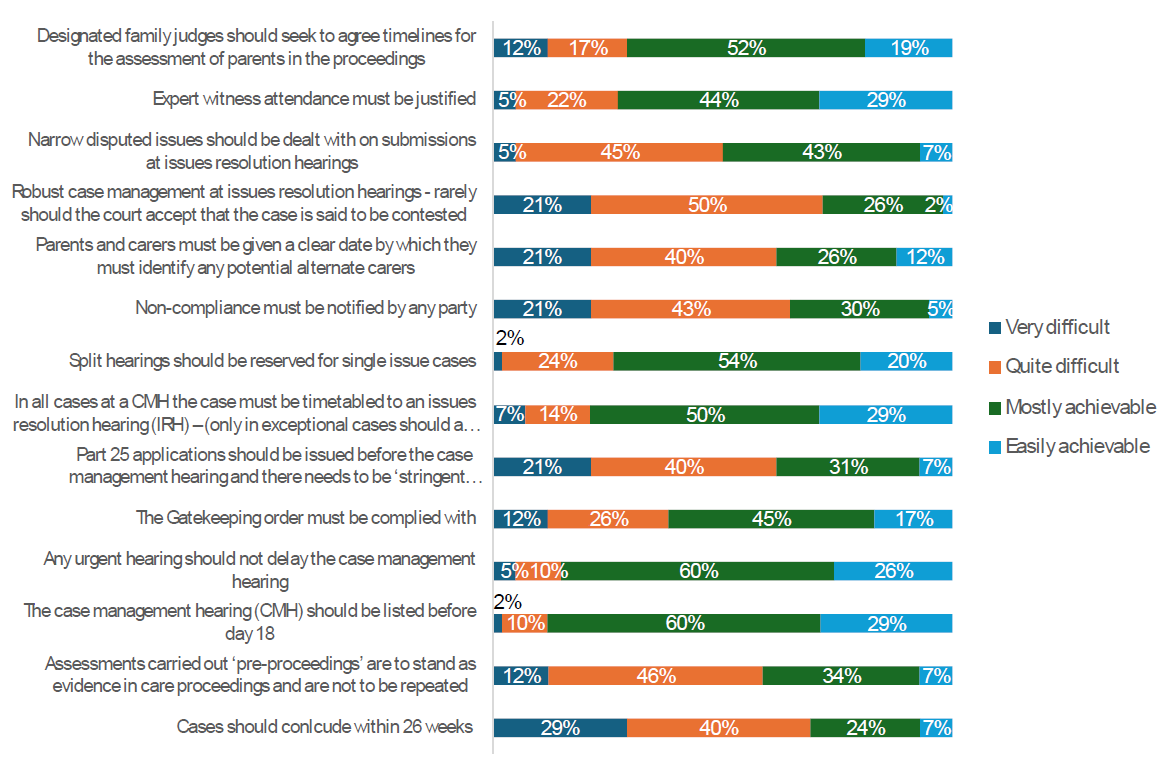
In 2023, the most difficult measure to achieve was expected to be: ‘Robust case management of the IRH to avoid stress & delay for children & parents. Rarely should the court simply accept that the case is said to be contested’.
Only 43% of respondents said this measure would be ‘easily achievable’ or ‘mostly achievable’, with 43% saying it would be ‘quite difficult to achieve’ and 14% saying it would be ‘very difficult to achieve.’
Three years on, this measure has in fact proved to be the most challenging in the experience of survey respondents, with 50% describing the measure as having been ‘quite difficult to achieve’ in practice, and 21% describing it as ‘very difficult’ to achieve.
Concerns were also expressed in relation to the following reforms:
- Non-compliance must be notified by any party (64% say ‘quite’ or ‘very’ difficult to achieve in practice);
- Parents and carers must be given a clear date by which they must identify any potential alternate carers (62% say ‘quite’ or ‘very’ difficult to achieve in practice);
- Part 25 applications should be issued before the case management hearing and there needs to be ‘stringent application of the necessity test’ (62% say ‘quite’ or ‘very’ difficult to achieve in practice);
- Assessments carried out ‘pre-proceedings’ are to stand as evidence in care proceedings and are not to be repeated (59% say ‘quite’ or ‘very’ difficult to achieve in practice);
- Narrow disputed issues should be dealt with on submissions at issues resolution hearings (50% say ‘quite’ or ‘very’ difficult to achieve in practice).
In light of the current tribulations within the system, the majority of respondents argued that further procedural reform is necessary, while some observed the difficulty of knowing what can be done to reduce delay in cases with more complexity.
“In respect of more straightforward cases, judges perhaps need to be stricter with parties in terms of not allowing extensions for filing of evidence if a deadline is missed without good reason”, one stated.
Other suggestions for change were highlighted as follows:
- Case management powers allowing the court to refuse repeated, unfounded changes to threshold compliance unless new information is provided.
- A national template confirming what is required for Re A compliance to prevent local variation in interpretation.
- More funding so local authorities can employ sufficient staff.
- Early listing of hearings with a circuit judge to look at proportionality of intervention.
- A justifiable limit on assessing family members that crop up after the first CMH.
- Uniform application of not starting assessments again when already completed in pre-proceedings.
- More time should be allowed in pre-proceedings to do the work needed in families without rushing into court where it is safe to do so.
Meanwhile, rejecting the notion of further reform as suggested by others, one respondent claimed a “change in judicial attitudes” is required instead, noting that workers are trying their best to adhere to “wholly unrealising timing”.
Echoing this view, anther pointed to “widespread bullying” from judges, adding: “Local Authority Lawyers are human beings acting on instructions.”
Taken together, the findings of Local Government Lawyer’s latest survey suggest that while the direction of travel since 2023 has been broadly positive, the ambition underpinning the 26-week timetable remains constrained by systemic pressures that procedural reform alone cannot resolve.
Sir Andrew’s 20-point plan has undoubtedly sharpened focus on discipline, preparation and case management, but the persistence of delay, particularly at the pre-proceedings stage, points to deeper issues of resourcing, engagement and consistency of approach across the system. As the family justice system moves forward, the challenge will not simply be to preserve momentum, but to balance the tension between procedural efficiency and the realities of complex family cases. Whether through further structural reform or increased investment, what is clear is that without a more holistic response, the ambition of resolving the majority of cases within 26 weeks is likely to remain more an ideal than an achievable norm.
Lottie Winson is a Reporter at Local Government Lawyer.
Sponsored articles


How Finders International Supports Council Officers

How hair strand testing should be instructed for family court proceedings
Jobs
























Senior Legal Adviser (Childcare)

Lawyer
Locums
Directory









Events