


AI Governance Professional (AIGP) - The Training Centre

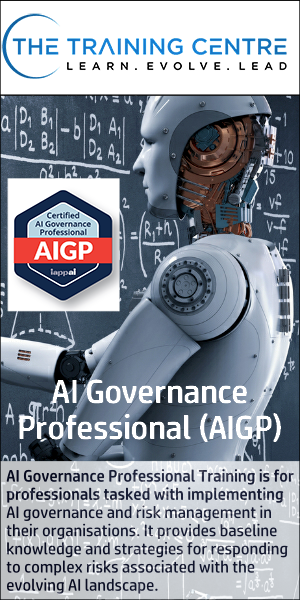
Aligned with the AIGP certification program, AI Governance Professional Training is for professionals tasked with implementing AI governance and risk management in their organizations. It provides baseline knowledge and strategies for responding to complex risks associated with the evolving AI landscape.
This training meets the rapidly growing need for professionals who can develop, integrate and deploy trustworthy AI systems in line with emerging laws and policies.
About This Course
This training teaches critical artificial intelligence governance concepts that are also integral to the AIGP certification exam. While not purely a “test prep” course, this training is appropriate for professionals who plan to certify, as well as for those who want to deepen their AI governance knowledge. Both the training and the exam are based on the same body of knowledge.
- Module 1: Foundations of artificial intelligence Defines AI and machine learning, presents an overview of the different types of AI systems and their use cases, and positions AI models in the broader socio-cultural context.
- Module 2: AI impacts on people and responsible AI principles Outlines the core risks and harms posed by AI systems, the characteristics of trustworthy AI systems, and the principles essential to responsible and ethical AI.
- Module 3: AI development life cycle Describes the AI development life cycle and the broad context in which AI risks are managed.
- Module 4: Implementing responsible AI governance and risk management Explains how major AI stakeholders collaborate in a layered approach to manage AI risks while acknowledging AI systems’ potential societal benefits.
- Module 5: Implementing AI projects and systems Outlines mapping, planning and scoping AI projects, testing and validating AI systems during development, and managing and monitoring AI systems after deployment.
- Module 6: Current laws that apply to AI systems Surveys the existing laws that govern the use of AI, outlines key GDPR intersections, and provides awareness of liability reform.
- Module 7: Existing and emerging AI laws and standards Describes global AI-specific laws and the major frameworks and standards that exemplify how AI systems can be responsibly governed.
- Module 8: Ongoing AI issues and concerns Presents current discussions and ideas about AI governance, including awareness of legal issues, user concerns, and AI auditing and accountability issues.
Accreditation
The associated exam is accredited by the IAPP under its ANSI Accreditation
Who Should Attend?
Any professionals tasked with developing AI governance and risk management in their operations, and anyone pursuing IAPP Artificial Intelligence Governance Professional certification.
Prerequisites
A general understanding of AI, Corporate Governance, and Business value would be of benefit to participants.
Assessment
The exam for AIGP is a 100 question, multiple choice exam to be completed within 180 minutes. Exams are hosted by Pearsonvue and can be taken either remotely, or via any one of hundreds of exam venues globally.
A passing score is achieved at 70%
Our Guarantee
- We are an approved IAPP training provider
- Exam pass guarantee, or retrain until you do, for free
What's Included?
- Participant Guide
- Practice Exam
- Exam voucher
- 14 hours of direct training from an AIGP Certified Instructor
- 1 years membership of the IAPP
This event will also take place:

Event Information
| Event Date | 17-09-2026 |
| Individual Price | £1,550.00 |
| Location | Online (live) |
Events













































 Training: BCS Practitioner Certificate in Data Protection - Blake Morgan
  Certified Data Protection Officer Training (CDPO) - The Training Centre
14-09-2026 9:00 am
Online (live)
 Cornerstone on the Court of Protection – Annual Training Conference - Cornerstone Barristers
14-09-2026 9:00 am
London
 HMPL Building Blocks: Defending Disrepair Claims - Law and Procedure - Devonshires
15-09-2026
Online (live)
 Subject Access Requests under the GDPR: A new weapon in the employment claimant’s arsenal? - 42BR
15-09-2026
Online (live)
 Driving Renewable and Sustainable Development in the Public Sector - DWF
15-09-2026 11:00 am
Online (live)
 Lewin Conference 2026 - New Square Chambers
  Beyond the Bench: Navigating Court of Protection Cases - Kings Chambers
  The Leasehold and Freehold Reform Act 2024: What Property Lawyers Need to Know - Cornerstone Barristers
16-09-2026
Online (live)
 Property Law Nuts & Bolts, Part 1: Boundary disputes - Landmark Chambers
  AI and Information Governance: Bridging Innovation and Compliance - Act Now
17-09-2026 10:00 am
Online (live)
European Data Protection & Privacy Programme Management - DPO Ready - The Training Centre
21-09-2026
Online (live)
 Breakfast Briefing on Green Belt after the 2026 NPPF: grey belt, golden rules and housing delivery - Francis Taylor Building
21-09-2026
London
 PATC | Update on care proceedings - Hugh James
  4-5 Housing Conference 2026 - 4-5 Grays Inn Square
  Building Safety Conference - Westminster Insight
  How to Handle a Subject Access Request - Act Now
Managing the Commercial Market Operator (CMO) principle in Subsidy Control - DWF
How to Handle a Subject Access Request - Act Now
Managing the Commercial Market Operator (CMO) principle in Subsidy Control - DWF
22-09-2026 11:00 am
Online (live)
Register for event alerts
On demand webinars

Sharpe Five Podcast - Episode 1: Understanding Access Injunctions

The A to Z of Housing Discrimination Case Law: R (FG) v Kensington and Chelsea

Placements of children in Scotland – implementation of the new law

The End of the Acid Test: What Every Advocate and Health & Social Care Professional Needs to Know

AI Can See Clearly Now 2026

Worth Your Data in Gold

Climate Law Matters: Live