

Data Ethics - Act Now

Data ethics is increasingly relevant to the role of information professionals. Just because the processing of personal data is lawful does not make it fair or 'ethical'.
And indeed, where something is fair it does not always mean it is lawful. Whilst the UK GDPR gives us some structure for working out what is a fair and proportionate use of personal data (and thus ethical), there can be a wide range of issues outside of the law to consider.This workshop will explore what the term 'Data Ethics' actually means, the role it plays in the use of personal data (and indeed other data) and what practical steps information professionals can take to embed and promote data ethics within their organisations.
From how to consider data ethics in DPIAs and sharing requests, through to embedding a practical data ethics framework in your organisation, we will pose questions, share experiences and best practice and where to find further guidance and support.
By the end of this workshop, you will understand the concept of 'data ethics', the role it plays in determining 'fairness, lawfulness and transparency' under principle 1, the role of Data Ethics in Data Sharing Frameworks, the link between various frameworks/standards on appropriate information use, what practical steps can be taken to embed data ethics within an organisation and what resources, guidance and regulations are in place or are coming.
Key Topics
- Ethics, Fairness & Lawfulness
- Practical considerations around 'fairness'
- Practical considerations around lawfulness
- Balancing 'fairness' and 'lawfulness' with Data Ethics
- Data Sharing
- What role does Data Ethics play in Data Sharing?
- Practical steps for highlighting and handling ethical considerations
- Data Protection Impact Assessments
- Embedding ethics questions into your DPIAs
- Managing risk and acceptance of risk
- Data Ethics Frameworks
- Example frameworks
- Links with other frameworks

Event Information
| Event Date | 07-04-2026 10:00 am |
| Individual Price | From £449 plus VAT |
| Location | Online (live) |
Events



































 Certified Information Privacy Professional (CIPP/E) - The Training Centre
  Annual Planning Seminar 2026 - No.5 Barristers
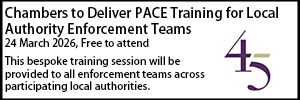
  Chambers to Deliver PACE Training for Local Authority Enforcement Teams - 4-5 Gray's Inn Square
24-03-2026
Online (live)
 Procurement and Public Law update - Ward Hadaway
  The ERA – Benefits and Working Conditions - Sharpe Pritchard
  The Law of Public Rights of Way, Commons and Town or Village Greens Seminar (Hybrid) - Francis Taylor Building
25-03-2026
London
 The Procurement Act 2023: The Role of The New Debarment and Exclusions Regime in Regulating Construction Products - 39 Essex Chambers
25-03-2026
London
 Family Law 'Know How' Talk Series: Discussing Sibling Assessments in Care Proceedings - College Chambers
26-03-2026 5:00 pm
Online (live)
 The Renters’ Rights Act: do’s, don’ts, red lines and heavy fines - Cornerstone Barristers
30-03-2026 11:00 am
Online (live)
 Assets of Community Value Revolution: Implications of the English Devolution and Community Empowerment Bill - Kings Chambers
30-03-2026 2:00 pm
Online (live)
 Building Safety Wales: The Future for Social Housing, Property Managers and Developers - Devonshires
31-03-2026 12:00 pm
Wales
 Understanding GDPR Accountability and Conducting Data Protection Audits - Act Now
02-04-2026 10:00 am
Online (live)
 How to Handle a Subject Access Request - Act Now
CCTV, Drones and Body Worn Cameras: Ensuring Data Protection Compliance - Act Now
How to Handle a Subject Access Request - Act Now
CCTV, Drones and Body Worn Cameras: Ensuring Data Protection Compliance - Act Now
10-04-2026 10:00 am
Online (live)
 Devolution and Local Government Reorganisation: beyond planning - Landmark Chambers
13-04-2026
Online (live)
HMPL Building Blocks: A Housing Officer’s Guide to Court Proceedings - Devonshires
14-04-2026
Online (live)
Register for event alerts

On demand webinars

The A to Z of Housing Discrimination Case Law - Akerman-Livingstone v Aster
Iris Ferber KC and Karolina Zielinska start at “A”: Akerman-Livingstone v Aster Communities, heard by the Supreme Court in 2015.

The A to Z of Housing Discrimination Case Law: Paragon Housing v Neville
Iris Ferber KC and Peter Jolley discuss Paragon Asra Housing v Neville, heard by the Court of Appeal in 2018.

The A to Z of Housing Discrimination Case Law: Nightingale v Bromford Housing
Iris Ferber KC and Natalie Foster discuss Nightingale v Bromford Housing, heard by the High Court in 2024.

The A to Z of Housing Discrimination Case Law: Laidley v Metropolitan Housing Trust
Iris Ferber KC and Matthew Timm discuss Laidley v Metropolitan Housing Trust, heard by the Court of Appeal in 2025: an important case about Equality Act assessors.

Leaving care provisions demystified!
Ann Osbourne and Alison Pryor discuss local authority duties under the Children Act 1989 and the Care Act 2014 – when the duties arise, what they encompass, human rights assessments, and the interface with the issues of immigration and homelessness.

Chickens, Fish and Lobsters - how are they protected?
42 Bedford Row provide an analysis of legal protections on particular species and case law in the area.

Interveners in financial remedy proceedings
To continue our current family law webinar series, Andrew and Catrin discuss practical tips for intervener claims in financial remedy proceedings – how to identify them, case management, preparing documentation and costs considerations.

Standish 18 months on
Paul Pavlou and Anne Hogarth revisit the case of Standish v Standish 18 months on, examining the judgment’s impact on financial remedy practice and emerging judicial trends, as well as presenting a general case law update.
