








Chamber of commerce and law firm call for changes to PQQ process in procurement
- Details
The North East Chamber of Commerce and law firm Dickinson Dees have published a report recommending improvements to the pre-qualification process in public procurement.
The report, Unlocking the Barriers, said that due to the relative size of the public sector within the North East, it formed an important part of the market for many businesses in the region. However, many perceived barriers which reduced their opportunity to compete for public sector contracts.
Compiled after focus groups were held involving both procurers and suppliers, the report suggested changes in four areas:
- Improving the PQQ debriefing process: “If procurers could adopt a more consistent approach on feedback at PQQ stage this would assist suppliers in improving future bids,” it said. “The use of a common template should assist with resource issues for procurers. The use of a common template among contracting authorities is recommended in this respect.” An example of good practice, based on documents used by Durham University, was proposed as a basis for such a template.
- Suitability of requirements checklist for procurers: “The importance of the involvement of smaller businesses and/or regional businesses in procurements run by contracting authorities in the region was acknowledged by all procurers and all try to ensure that there are no barriers to participation,” the report said. “However, there were a number of areas where it was agreed that a checklist approach could aid contracting authorities in considering (at pre-procurement stage) how best to structure a procurement process so that there are no inadvertent barriers to effective participation.” A sample checklist was proposed.
- Improving the transparency of the PQQ evaluation: “The majority of the PQQ is now Pass/Fail but in qualitative areas (and in some instances the pass/fail areas as well) suppliers found that some PQQs were less transparent than others in how they would be evaluated,” the report found. “Improving the clarity and transparency of the PQQ evaluation methodology not only assists suppliers, who can customise their submissions appropriately, but also procurers as it aids the evaluation process and reduces the risk of formal or informal challenge.” General consideration to improving the transparency and clarity of the PQQ evaluation process was therefore recommended.
- Supplier engagement: Contracting authorities reported that supplier engagement at open days or events was generally poor. “In order that contracting authorities can better understand what regional businesses can offer and to assist with pre-procurement planning it is vital that regional suppliers engage with procurers,” the report said. A key recommendation for suppliers was that they take up appropriate opportunities to engage with North East procurers.
The report acknowledged that the changes would not be a panacea for all suppliers’ concerns with the procurement process.
“National policy with regard to frameworks and buying consortia; maintenance of high quality information on the supply market; effective strategies within procurement categories enabling communication of a future ‘pipeline’ of work; and development of meaningful metrics on the economic impact of procurement are all issues which will need to be tackled,” it said.
“But achieving quick wins through the pre-qualification process would be a real help to suppliers while these more medium-term issues are addressed.”
Writing in the foreword, Deborah Ramshaw of Dickinson Dees said the recommendations represented best practice within the public procurement sector.
She added: “Their implementation would make a real difference to suppliers seeking greater access to the public sector both within the region and further afield.”
An estimated £3.5bn is spent by the public sector in the North East each year buying goods and services.
The North East Chamber of Commerce and law firm Dickinson Dees have published a report recommending improvements to the pre-qualification process in public procurement.
The report, Unlocking the Barriers, said that due to the relative size of the public sector within the North East, it formed an important part of the market for many businesses in the region. However, many perceived barriers which reduced their opportunity to compete for public sector contracts.
Compiled after focus groups were held involving both procurers and suppliers, the report suggested changes in four areas:
- Improving the PQQ debriefing process: “If procurers could adopt a more consistent approach on feedback at PQQ stage this would assist suppliers in improving future bids,” it said. “The use of a common template should assist with resource issues for procurers. The use of a common template among contracting authorities is recommended in this respect.” An example of good practice, based on documents used by Durham University, was proposed as a basis for such a template.
- Suitability of requirements checklist for procurers: “The importance of the involvement of smaller businesses and/or regional businesses in procurements run by contracting authorities in the region was acknowledged by all procurers and all try to ensure that there are no barriers to participation,” the report said. “However, there were a number of areas where it was agreed that a checklist approach could aid contracting authorities in considering (at pre-procurement stage) how best to structure a procurement process so that there are no inadvertent barriers to effective participation.” A sample checklist was proposed.
- Improving the transparency of the PQQ evaluation: “The majority of the PQQ is now Pass/Fail but in qualitative areas (and in some instances the pass/fail areas as well) suppliers found that some PQQs were less transparent than others in how they would be evaluated,” the report found. “Improving the clarity and transparency of the PQQ evaluation methodology not only assists suppliers, who can customise their submissions appropriately, but also procurers as it aids the evaluation process and reduces the risk of formal or informal challenge.” General consideration to improving the transparency and clarity of the PQQ evaluation process was therefore recommended.
- Supplier engagement: Contracting authorities reported that supplier engagement at open days or events was generally poor. “In order that contracting authorities can better understand what regional businesses can offer and to assist with pre-procurement planning it is vital that regional suppliers engage with procurers,” the report said. A key recommendation for suppliers was that they take up appropriate opportunities to engage with North East procurers.
The report acknowledged that the changes would not be a panacea for all suppliers’ concerns with the procurement process.

“National policy with regard to frameworks and buying consortia; maintenance of high quality information on the supply market; effective strategies within procurement categories enabling communication of a future ‘pipeline’ of work; and development of meaningful metrics on the economic impact of procurement are all issues which will need to be tackled,” it said.
“But achieving quick wins through the pre-qualification process would be a real help to suppliers while these more medium-term issues are addressed.”
Writing in the foreword, Deborah Ramshaw of Dickinson Dees said the recommendations represented best practice within the public procurement sector.
She added: “Their implementation would make a real difference to suppliers seeking greater access to the public sector both within the region and further afield.”
An estimated £3.5bn is spent by the public sector in the North East each year buying goods and services.
Sponsored articles


Walker Morris supports Tower Hamlets Council in first known Remediation Contribution Order application issued by local authority
Jobs


Chief Lawyer - Contracts

Principal Lawyer
Solicitor

Senior Planning Lawyer

Lawyer - Contract, Procurement and Information Law

Litigation Lawyer
Locums
Directory



Events
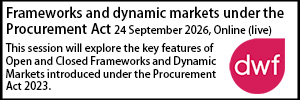
22-09-2026 11:00 am
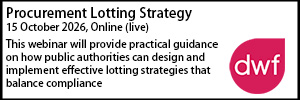
14-10-2026 4:00 pm
18-11-2026 11:00 am
01-12-2026
To Be Confirmed
To Be Confirmed
To Be Confirmed
